Take the first step to starting your new career in 2026!




And join over 63,000+ students who passed the UBC Exams




Are you currently a real estate student (or planning to be in the near future) and registered to take the CELPIP test in BC? Did you visit the study and preparation section of the CELPIP website and feel totally overwhelmed and overloaded by the information?
You wouldn’t be the first.
Even if English is your first language and you did ok in high school or college, going through some of the study materials might leave you feeling a bit of anxiety. The sheer volume of resources alone can make it hard to know where to start.
The good news is that there plenty of resources to help get you ready for the CELPIP test.
The better news is that we are going to share a break down and some strategies to help you pick and choose the resources that will be the most helpful for you.
It is hard to know where to start, much less where to focus your time and energy if you don’t know what your current proficiency levels are (how good or bad you are) in each of the four sections: reading, writing, listening, and speaking.
The best place to start your preparation is also the way you will figure out what areas of English you are good at, and which ones need work. You should start by taking one of the two free CELPIP Sample Tests offered on the CELPIP website (they include answer keys and listening transcripts).
Taking the online sample test has a number of benefits. For those who are not experienced at test taking or who find that tests make them overly anxious, practice tests are the perfect way to get more comfortable and familiar with the process of taking tests and specifically the format and timing of the CELPIP test. Doing this will let you experience the different types of questions you will find in each section, see how they are worded and learn what answers they are looking for in response.
After you have completed the test, if a section was easy for you to complete, and you get the answers right (there are right and wrong answers provided for the Listening and Reading components), you know that these areas will need less focus. For those sections that you found difficult, got answers wrong or had to spend extra time in, these are the sections where you will want to focus the majority of your time in preparation.
Before diving into resources and activities to prepare you for the test, here is a quick breakdown guide of each section and what skills you will be using.
Purpose: Measures how well you understand English in everyday situations (conversations, problem-solving, news, and discussions).
Format: 47–55 minutes, 6 scored parts (plus an unscored trial question).
Questions: All are multiple-choice; answers are computer-scored.
Audio Clips: Each is played only once (no transcripts in the real test).
Purpose: Measures ability to communicate clearly in everyday situations.
Format: 15–20 minutes, 8 tasks (plus 1 practice). For each task you are given either 30 or 60 seconds to prepare your answer. You then give the answer for each task. Most tasks are allotted 60 seconds, and a couple give you up to 90 seconds. It is important to make sure you give your most complete answer in the time given.
Note that the time you are given to speak for a task is called “Recording Time” in the test.
Scoring: Rated by human raters on content, vocabulary, listening comprehension, and delivery (pronunciation, fluency, intonation).
Tips: Speak naturally, organize ideas clearly, use specific examples, and avoid long pauses.
Purpose: Tests ability to understand written English in personal, workplace, and social contexts.
Format: 55–60 minutes, 4 parts (38 Qs total).
Skills Tested: Skimming, scanning, inference, distinguishing fact vs. opinion, recognizing paraphrases.
Purpose: Measures ability to write clearly in everyday tasks.
Format: 53–60 minutes, 2 tasks (150–200 words each).
Now that you know what to expect for each section of the exam, it is time to choose and access the many materials they offer to prepare for taking the test.
The first place to start with your preparation is by accessing the abundant free resources offered on the CELPIP website.
They provide a wide variety of print and video materials as well as live online webinars for students to easily access via Zoom.
Start by attending a general Info Session. Hosted by a CELPIP expert, attending a session will give you a general understanding of all parts of the test with a detailed look at the Writing and Speaking sections. A real person will share the test format, procedure, scoring, and list the available study materials they think will be most helpful. You will even have the opportunity to ask any questions you have during the session.
Once you have feel you have some basic fluency in one of the four skills you can attend a the corresponding webinar: CELPIP Reading Pro, CELPIP Speaking Pro, CELPIP Writing Pro and CELPIP Listening Pro . These webinars are usually available a couple times a month, are hosted by a CELPIP expert, allow you to ask questions live, and provide you with relevant study and practice materials for the relevant skill.
Additionally, on the free page you will find the link to the CELPIP YouTube channel and their blog. Both platforms share numerous additional resources and information to help you prepare.
If you are looking for additional materials, CELPIP sells a number of excellent resources, guides and tutorials on their Paid Study Materials page. These range from additional practice tests to guides that will help you expand your vocabulary and explain some of the most common CELPIP errors.
If you are looking for more interactive ways to prepare, here are our top five practice activities that combine and work on multiple skills at once.
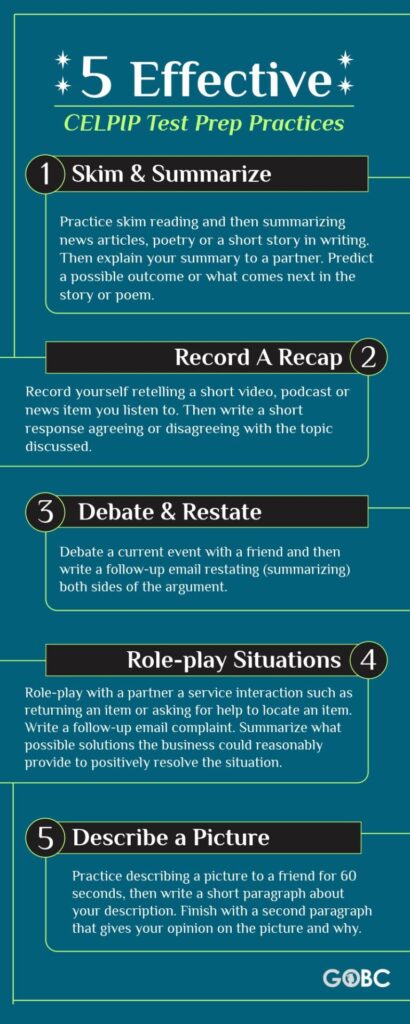
Here are 5 practice activities that hit multiple CELPIP skills at once:
Click Image to open full size version.
Practice skim reading and then summarizing news articles, poetry or a short story in writing. Then explain your summary to a partner. Predict a possible outcome or what comes next in the story or poem.
Record yourself retelling a short video, podcast or news item you listen to. Then write a short response agreeing or disagreeing with the topic discussed.
Debate a current event with a friend and then write a follow-up email restating (summarizing) both sides of the argument.
Roleplay with a partner a service interaction such as returning an item or asking for help to locate an item. Then write a follow-up email complaint. Summarize what possible solutions the business could reasonably provide to positively resolve the situation.
Practice describing a picture to a friend for 60 seconds, then write a short paragraph about your description. Finish with a second paragraph that gives your opinion on the picture and why.
Start by having conversations with fluent English speakers whenever you get the chance. Activities such as shopping and ordering food are excellent examples of times where you can practice, if you do not know anyone fluent.
It is also extremely beneficial to read every day. This will quickly increase your reading comprehension and speed. Start with reading materials that interest you. This can be any book with words and can include:
The point is to practice every day. As often and as much as you can.
It can also be very helpful to write a daily journal. Just before bed is a great time to write a minimum of 200 words summarizing what happened over your day. This regular practice will make it much easier and faster for you to take a topic and write about it. You can practice new words you have learned, increasing your vocabulary. As you become more fluent, you can really focus on your grammar and writing sentences and paragraphs that are direct, clear and have good flow.
There is no shortage of resources to help you prepare for the CELPIP exam. But your time is precious, and you want to ensure that you are making the most of your time and focusing your energies where they are needed and with the resources and tools that are most effective for you.
This starts by taking the sample tests and understanding where you currently stand with each of the four key skills. Once you know what needs to be worked on, experiment with the different resources and activities to find the ones that best help you learn and become proficient.
Ultimately, the more you can incorporate English into your everyday life, the more quickly you will develop the proficiency needed to pass the exam and move on to the next steps of becoming a licensed real estate agent in British Columbia.
Still deciding if GOBC is right for you? Why not see for yourself?
Our free trial gives you immediate access to real lessons, study
tools, and resources used by successful BC licensing students.
Get a feel for the structure, clarity, and support that make GOBC one of BC’s most trusted real-estate education providers.
🚀 [Start Your Free Trial Today →]
Ever wondered what learning with GOBC feels like? 🎓
Before you dive into your licensing course, take a front-row seat in our free video class — Sources of Law (2025) — on YouTube.
You’ll meet one of our instructors, explore how GOBC makes complex topics clear and practical, and get a feel for the engaging, student-focused approach that’s helped thousands of learners pass their exams with confidence.